5 water quality parameters every hatchery should log daily
Oxygen, temperature, pH, CO₂ and ammonia: what to look at in each one, why it matters and how to turn daily logs into early alerts.
In a freshwater hatchery, most health problems give a warning before they show: oxygen that drops little by little, a pH that drifts, or ammonia rising in a heavily stocked room. Catching it early or late usually comes down to logging every day, at the same time and in the same way.
1. Dissolved oxygen
It is the most critical parameter and the one that changes fastest. Log it in mg/L and as percent saturation, ideally at the outlet of each tank, where the water is poorest. A common reference is to keep the outlet above 80 % saturation, but the right threshold depends on the life stage, temperature and stocking density of each room.
2. Temperature
It sets the fish's metabolism: higher temperature means more oxygen consumption, higher feeding rates and more waste. Logging it together with oxygen explains why the same O₂ value is enough in winter and too low in summer.
3. pH
It directly affects ammonia toxicity and the CO₂ balance. In recirculating systems (RAS) it tends to fall over time because of nitrification, so a sustained drop is an early sign that alkalinity needs adjusting.
4. Dissolved CO₂
It is easy to forget because you cannot see it, but in dense rooms or with poor degassing it builds up and affects welfare and growth. Many hatcheries work with references in the order of 10 to 15 mg/L as a maximum, always validated with their technical team.
5. Ammonia (TAN)
Total ammonia nitrogen comes from excretion and uneaten feed. Its toxic fraction (un-ionised ammonia) increases with pH and temperature, so the number alone is not enough: read it together with those two parameters.
From logging to early warning
Logging is of little use if nobody compares today's value with yesterday's. What makes the difference is:
- Thresholds per room and life stage, not a single value for the whole hatchery.
- Automatic alerts when a value goes out of range, sent to whoever is on shift.
- Trends: a value inside the range that has been falling for three days is also an alert.
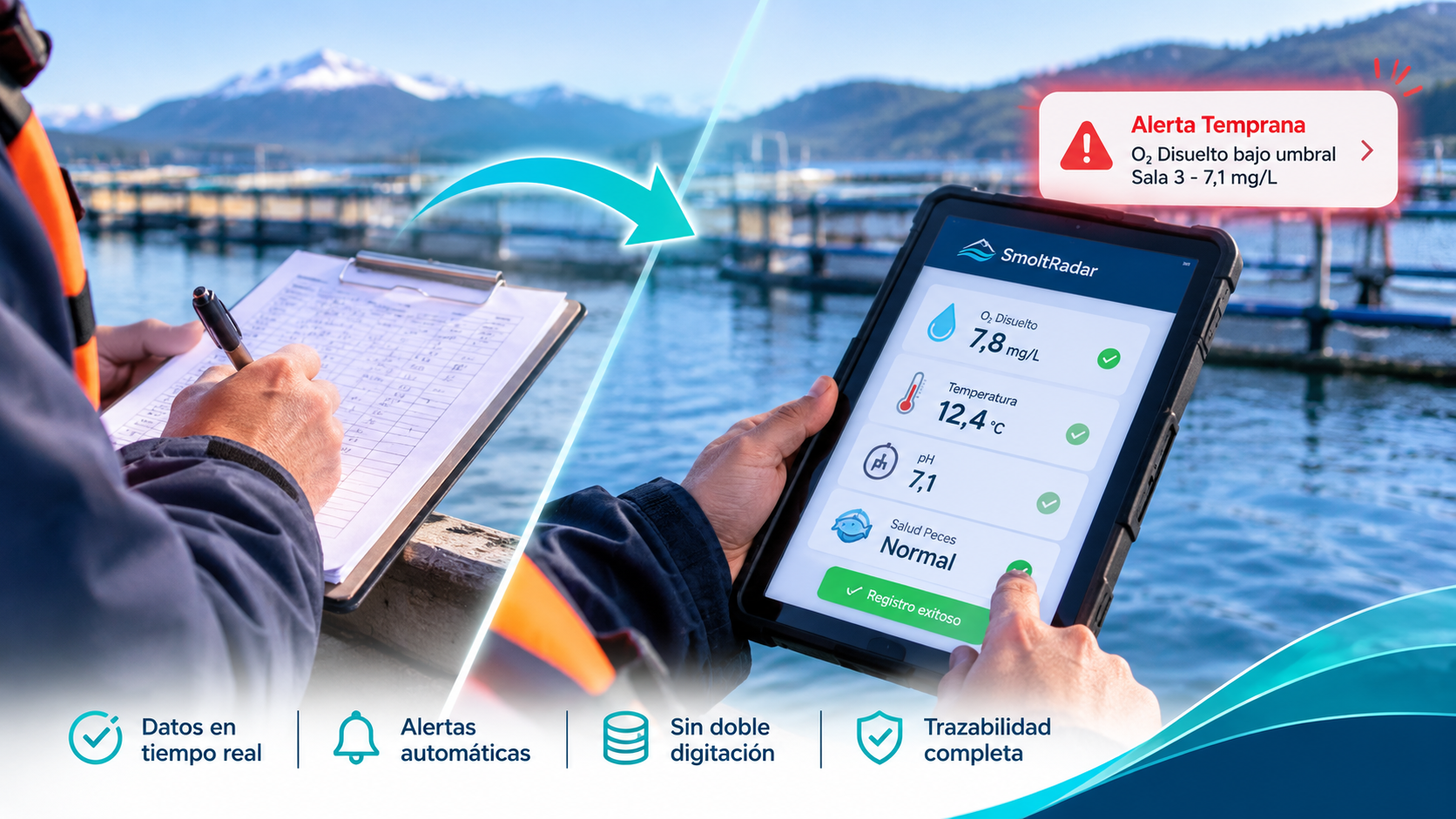
In SmoltRadar every sample is compared with its room's thresholds and with previous records, and any deviation is notified by email, WhatsApp or SMS.
The values mentioned are for reference only. Each hatchery should define its ranges with its veterinarian and according to applicable regulations.